Designers must evolve from technical craft to high-level strategic reasoning.
Key Takeaways
The creative sector is undergoing a profound transformation as AI reshapes the boundaries of possibility. This guide outlines how professionals can adapt by shifting from manual execution to strategic curation and human-centric problem solving.
Designers must evolve from technical craft to high-level strategic reasoning.
Generative tools require new skills in prompt engineering and data literacy.
Leadership focus should shift toward building multidisciplinary, AI-fluent teams.
Ethical guardrails around intellectual property and algorithmic bias are non-negotiable.
A hybrid portfolio balancing traditional craft with AI-assisted output is essential for future relevance.
The evolution of the creative workflow
Designers have always adapted to new technology, from the earliest digital tools to the rise of responsive web platforms. The current shift toward generative models is unique in its breadth, moving the focus away from hours spent on production and toward the orchestration of machine-assisted creative outputs. Understanding this transition is essential for those looking to influence the ai design future.
Moving from manual craft to generative curation
The shift from maker to curator represents a fundamental change in the daily life of a designer. Instead of spending days rendering pixels, professionals are increasingly using tools to iterate through conceptual variations in seconds. This allows for a deeper exploration of ideas, moving the designer's primary value away from technical proficiency and toward aesthetic discernment.
Speeding up iteration cycles with machine learning
Machine learning has dramatically reduced the friction between a raw idea and a high-fidelity prototype. By leveraging predictive models, creative teams often find that exploration phases are no longer bottlenecks, but rather rich discovery periods. This newfound speed helps in testing assumptions early, a process that Noran Design often advocates when refining digital products to ensure they deliver tangible business value.
Integrating AI tools into current design stacks
Adopting AI doesn't mean discarding existing workflows; it means optimizing them. Organizations looking to maintain speed while ensuring consistency often implement modular systems that integrate generative AI within their familiar creative software.
Tool Category | Core Benefit | Integration Effort |
|---|---|---|
UI Generation | Rapid Wireframing | Low |
Asset Creation | Scalable Imagery | Medium |
Code Translation | Design to Build | High |
By layering these technologies appropriately, teams can avoid the common trap of fragmented output and instead build a more cohesive creative ecosystem.
Essential skills for the AI-powered designer

Navigating the current landscape requires a proactive approach to skill development that goes beyond simply learning a new software update. Designers are shifting their focus to the intersection of technology and human intent, where the strategic design process itself becomes the most valuable asset in their toolkit.
Mastering prompt engineering for visual outputs
Prompting is not merely about typing commands; it is about learning the language of the underlying model to achieve specific, high-quality results. To remain effective, designers should focus on several core prompting pillars:
Defining the intended tone and visual style clearly.
Iterating on descriptive constraints to refine the focus.
Blending distinct artistic or functional concepts to spark innovation.
Validating outputs against existing brand guidelines.
By mastering these steps, creators can move from trial-and-error to intentional generation.
Data literacy and contextual decision-making
As AI provides more data-backed insights, the ability to interpret that information within a broader business context becomes vital. Designers must now bridge the gap between creative intuition and empirical evidence, ensuring their decisions are not just visually sound but also logically grounded to support stakeholder goals.
Enhancing empathy and human-centric strategy
While machines can output content, they lack the emotional intelligence to understand the nuanced needs of end users. Human-centric strategy remains the bedrock of great UX, ensuring that design solutions truly serve the people they are intended for rather than simply filling digital space.
Transforming design leadership and strategy
Leading in an AI-augmented environment requires a shift in how we manage creative assets and team growth. Leaders must act as architects of workflow, deciding where automation delivers the most impact without sacrificing the human spirit necessary for building long-term brand equity.
Scaling design operations via automated systems
Scaling operations requires a clear understanding of the balance between automated tasks and manual oversight. Without thoughtful orchestration, rapid production can easily lead to a dilution of the very quality a brand represents.
The most successful teams treat AI as a partner in the process, ensuring that every automated efficiency step serves the broader goal of maintaining clear, consistent communication throughout the user experience.
This approach ensures that while the output scales, the depth and precision of the brand message remain intact.
Balancing production efficiency with brand consistency
Maintaining a unified identity requires rigorous systems that govern how AI-produced assets integrate with core assets. It is about using automated scaling responsibly to support, rather than override, the established visual language of the organization.
Cultivating multidisciplinary teams that leverage AI
Future teams will be composed of individuals with diverse backgrounds—from engineering to behavioral psychology—who utilize AI as a collaborative teammate. Building this cross-functional environment encourages a more experimental approach to problem solving, ultimately driving creative growth and innovation.
Ethical considerations in the AI design future
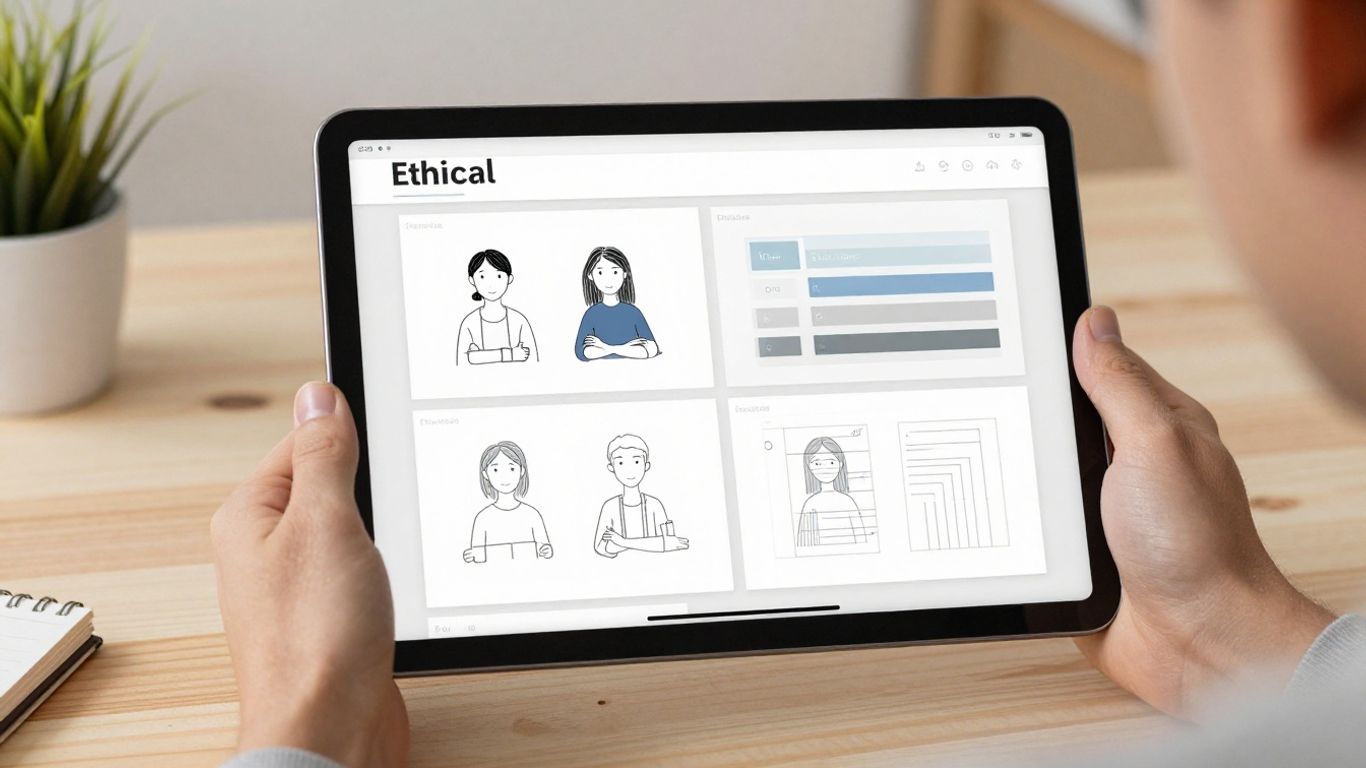
As the impact of generative tech expands, the industry must grapple with its inherent influence on creators and the public. Maintaining ethical standards isn't just about compliance; it's about protecting the integrity of the work and the culture of the creative community itself.
Addressing copyright and intellectual property challenges
The gray area of data scraping and model training remains a central concern for the profession. Designers should practice diligence by vetting the tools they use, ensuring that their creative outputs don't inadvertently rely on problematic sources or violate the rights of other artists.
Mitigating algorithmic bias in design outputs
Bias in AI is often a reflection of the datasets used in training models. By acknowledging these limitations, designers take ownership of their outputs, performing thorough reviews to ensure the content they generate is inclusive and representative of the intended, diverse audience.
Maintaining transparency regarding the human role in creation
Being open about the role of technology in a project builds trust with clients and users. Transparency about the use of AI tools versus manual craft helps ground the value of a final design in reality rather than hype.
Challenges facing the design industry
The rise of automated tools threatens to saturate the market with low-effort work, making the role of the professional curator more crucial than ever. Maintaining high standards throughout this period of intense flux is essential for long-term viability.
The commodity trap of mass-generated content
When entry barriers to professional-looking visual content disappear, the market risks devaluing technical execution. Differentiation will rely on the quality of the strategy behind the imagery, not just the imagery itself.
Preserving the emotional resonance of boutique design
Mass production often lacks the authentic touch that defines boutique work. Ensuring that human storytelling remains at the center of the creative process is the best defense against the homogenization of digital experiences.
Navigating market shifts and role redefinitions
Roles are changing, but the need for problem-solvers is higher than ever. Adapting to this evolving role requires an open mind and a commitment to refining one's core value proposition in a market that is increasingly tech-leveraged.
Future-proofing your professional practice
Preparation for changes is a key element of a successful creative career. By focusing on fundamental human values while embracing technological efficiency, designers can navigate the transition with confidence.
Building a hybrid portfolio of traditional and AI-assisted work
A strong portfolio should showcase the ability to combine distinct methods to achieve specific goals. It proves that you understand both the power of machine-generated speed and the necessity of human refinement.
Continuous learning in a fast-paced technology cycle
Technology changes quickly, and the capacity for ongoing adaptation is a critical skill. Designers must view learning as a perpetual state rather than a destination, ensuring they are always exploring new ways to enhance their craft.
Positioning design expertise as a strategic business partner
Design is ultimately about solving business problems through creativity. Professionals who frame their skills as a strategic input for growth will find themselves indispensable, regardless of the tools they use to get the job done.
Conclusion
The move toward an AI-driven environment is an opportunity to elevate the creative field from mere execution to higher-order strategy. By balancing technical agility with deep human empathy and rigorous ethical judgment, designers can thrive, ensuring their work continues to resonate in an increasingly automated world.
Frequently Asked Questions
How will AI change daily design tasks?
AI will likely automate repetitive tasks like resizing assets, organizing folders, and generating baseline layouts, allowing you more time for high-level strategy.
Is it possible to maintain brand quality with AI?
Yes, provided that a clear design system is in place and all AI-generated assets undergo human-led quality assurance to ensure they align with brand goals.
Does AI replace the need for art school?
Technical proficiency can be learned through various channels, but the fundamental lessons in critical thinking, aesthetics, and user empathy remain central to a comprehensive design education.
What are the main ethical concerns to watch?
Primary concerns include intellectual property rights, data provenance, and the potential for algorithmic bias to impact user-facing content.
Should I focus on learning new AI tools?
Focusing on understanding how to leverage new tools to solve problems is more important than memorizing the specific interface features of any single one.
How do I maintain my creative voice?
Your creative voice is found in the choices you make, the vision you set, and the refinement you provide, all of which remain uniquely your own despite technological shifts.
Will design jobs disappear?
While some entry-level execution roles might evolve, the demand for human strategy and nuanced design judgment is expected to grow alongside the complexity of the tools we use.